
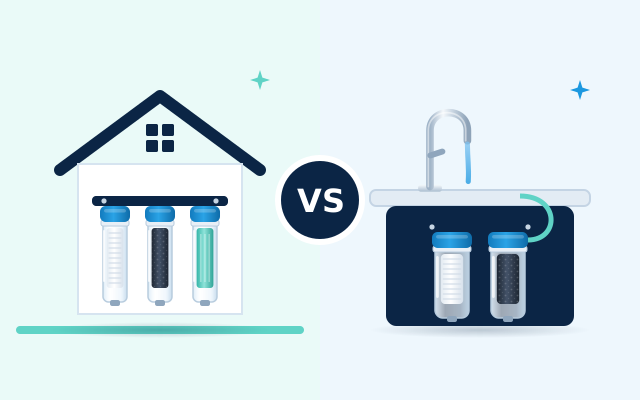
The biggest decision when choosing a water filter isn’t the brand or the number of stages. It’s where the filter goes. A whole house system treats water as it enters your home, while an under sink system treats the water you drink. Here’s how to work out which suits you.
Point of entry vs point of use
A point-of-entry system is installed on the main water line where it enters your home, usually near the water meter. Every tap, shower and appliance after that point gets filtered water. That’s a whole house system.
A point-of-use system treats water at a single outlet. Under sink filters are the most common example: they sit in the kitchen cupboard and feed a dedicated filter tap for drinking and cooking. Benchtop and shower filters are point-of-use too.
Whole house filters: pros and cons
Pros
- Filtered water from every tap, shower and appliance, including the laundry.
- Less chlorine taste and smell throughout the home, including in the shower, where many people notice it most.
- A sediment stage helps protect your hot water system, taps and appliances from grit and rust.
- One system to look after, mounted out of the way.
Cons
- A higher upfront cost, and larger cartridges to replace.
- Installation by a licensed plumber, plus suitable wall space near the main line.
- Every litre you use passes through it, including water for toilets and washing, so cartridges work harder.
- Not usually an option for renters without the landlord’s approval.
Under sink filters: pros and cons
Pros
- A lower upfront cost, with smaller, cheaper cartridges.
- Filtration focused on the water you actually drink and cook with.
- Hidden in the kitchen cupboard, with a separate dedicated tap.
- The option of a higher level of treatment, such as reverse osmosis, just for drinking water.
Cons
- Only one tap is filtered, so showers and bathroom taps are not.
- It takes up cupboard space, and reverse osmosis also needs room for a storage tank.
- Connecting to your water supply generally needs a licensed plumber, in line with your state’s plumbing regulations.
- Reverse osmosis sends a portion of water to the drain as part of the process.
Side-by-side comparison
| Feature | Whole house | Under sink |
|---|---|---|
| Where it goes | On the main line where water enters the home | In the kitchen cupboard, with a dedicated tap |
| What it filters | Every tap, shower and appliance | Drinking and cooking water at one tap |
| Upfront cost | Higher | Lower |
| Installation | Licensed plumber | Usually a licensed plumber |
| Maintenance | 20-inch cartridges, typically every 6 to 12 months | Smaller cartridges every 6 to 12 months; reverse osmosis membranes every 2 to 3 years |
| Space | Wall space near the main line | Room in the sink cupboard |
| Renters | Needs landlord approval | Needs landlord approval |
| Best for | Chlorine and sediment throughout the home | The most thorough treatment of drinking water |
Who each option suits
A whole house system suits you if:
- you own your home and want filtered water everywhere, including the shower
- chlorine smell in the shower or bath bothers you
- sediment or rust is marking fixtures or clogging tap aerators
- you’re on tank or bore water, which is best treated where it enters the home, usually with UV disinfection
- you want PFAS treatment for the whole household, which is what our whole house PFAS system is designed for
An under sink system suits you if:
- your main goal is better-tasting drinking and cooking water
- you want to reduce fluoride, PFAS, heavy metals or dissolved salts in your drinking water, which is where reverse osmosis comes in
- you’d like to start with a smaller investment
- you live in an apartment or smaller home and have approval to make a plumbing connection
Why not both?
Many households combine the two. A whole house system reduces chlorine and sediment at every tap and shower, and an under sink reverse osmosis system at the kitchen sink adds a higher level of treatment for drinking water.
This pairing suits homes with specific concerns, such as fluoride or PFAS in drinking water, and means you only pay for the most thorough treatment on the water you drink.
Where benchtop and shower filters fit
Benchtop filters sit beside the sink and connect to your existing tap with a diverter. There’s no plumbing, so they suit renters and apartments and move house with you. Ours is designed to reduce chlorine, sediment, tastes and odours.
Shower filters fit between the shower arm and shower head in minutes and are designed to reduce chlorine. They’re a simple option if a whole house system isn’t possible.
Neither replaces reverse osmosis for concerns like fluoride or PFAS, but both are an easy, affordable place to start.